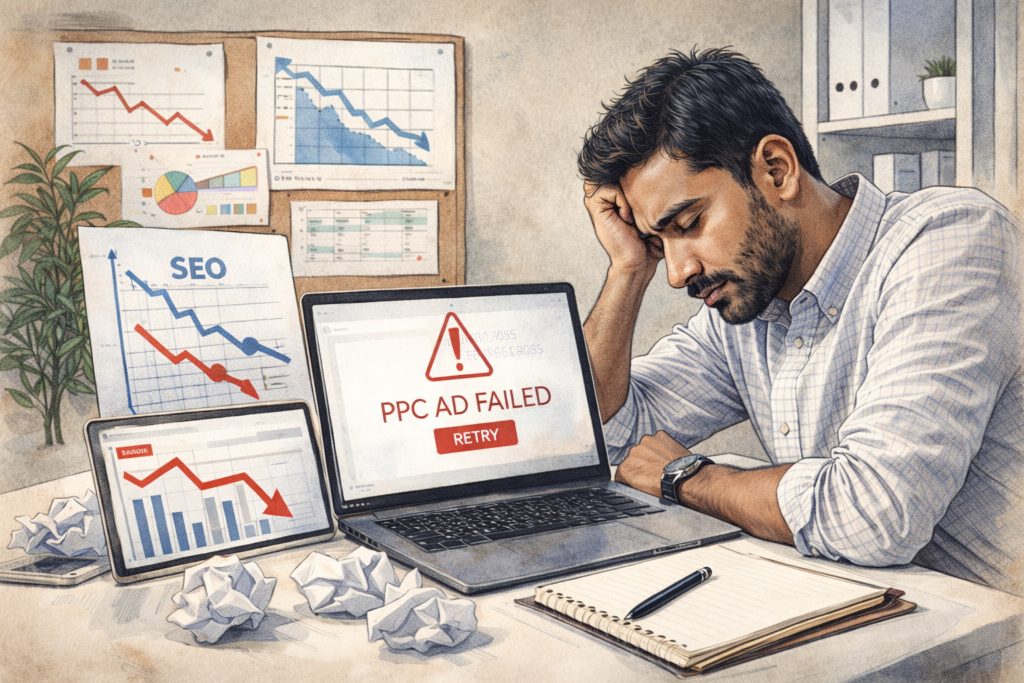
Why digital marketing fails for many businesses becomes clear when you look beyond ads, tools, and platforms.
Despite spending lakhs every year, many companies struggle to see consistent leads, real sales growth, or clarity on return on investment.
Ads keep running.
SEO work continues.
Social media posts go out regularly.
Yet enquiries remain inconsistent, pipelines stay weak, and business owners are left wondering where the money actually went.
This problem is not rare. It is extremely common across small and medium businesses.
Digital marketing does work. It works very well when done correctly. The real issue lies in how digital marketing is planned, executed, and evaluated.
This article explains why digital marketing fails, even after significant spending, based on real agency experience across different industries.
Digital Marketing Fails When the Business Goal Is Not Clear
The most common reason why digital marketing fails is the absence of a clear business goal.
Many businesses say they want more leads, better branding, or online visibility. These are expectations, not measurable goals.
Some businesses want immediate sales.
Some want long term brand authority.
Some want qualified leads for their sales teams.
When campaigns are launched without defining one primary objective, success becomes impossible to measure. Every result feels either insufficient or confusing.
This is one of the main reasons why digital marketing fails even for businesses that invest large budgets.
A focused digital marketing strategy works only when one clear goal is defined and all efforts support that goal.
Trying Everything at Once Dilutes Results
Another major reason digital marketing fails is trying to do everything at the same time.
Many businesses invest in SEO, Google Ads, social media marketing, email campaigns, and marketplaces together. Budgets get divided, attention gets scattered, and performance becomes difficult to analyze.
When everything is active:
- No channel gets enough focus
- Results overlap and confuse reporting
- Optimization becomes slow
Digital marketing is not about doing more.
It is about doing the right things in the right order.
Businesses that focus on one or two channels at a time almost always see better results than those trying to be everywhere.
Lack of Strategy Leads to Wasted Spend
Most digital marketing failures are not caused by bad platforms or tools.
They are caused by missing strategy.
Common examples include:
- Running ads without optimized landing pages
- Publishing content without understanding search intent
- Posting on social media without audience clarity
- Investing in SEO without fixing site structure
These actions create activity, not outcomes.
Effective digital marketing services always begin with planning. Without a clear strategy, execution becomes random and results remain inconsistent.
Wrong Expectations From the Wrong Channels
Every digital marketing channel has a specific role.
SEO builds long term visibility and trust.
Google Ads deliver immediate, intent driven traffic.
Social media builds awareness and credibility over time.
Problems arise when businesses expect:
- Instant results from SEO
- Long term growth from ads alone
- High sales from organic social media
When channels are used for the wrong purpose, even good execution feels like failure.
Google itself explains how search works and how websites are evaluated in the Google Search Central documentation, yet these fundamentals are often misunderstood in real world execution.
Budget Allocation Is Often Unrealistic
Budget decisions play a major role in performance.
Some businesses expect strong results with minimal spend across multiple channels. Others overspend on ads without investing in conversion optimization, content, or tracking.
Digital marketing budgets need balance.
- Ads without landing page optimization waste traffic
- SEO without time and patience wastes effort
- Small budgets split across many channels weaken impact
Results improve when budgets align with goals, timelines, and realistic expectations.
Data Is Collected but Rarely Used Properly
Almost every business tracks data.
They have access to analytics dashboards, ad reports, keyword data, and traffic numbers. But very few businesses use this data to change decisions.
Reports are reviewed, but strategies remain unchanged. Campaigns continue the same way month after month.
Digital marketing improves only when data drives action. Testing, learning, and refinement are what lead to growth. Without this feedback loop, performance plateaus.
Agency Changes Do Not Fix Structural Problems
Many businesses switch agencies frequently, hoping for better results.
While poor agencies do exist, results often suffer due to misalignment rather than execution alone.
Common issues include:
- Unclear communication
- Unrealistic timelines
- No involvement from the business side
- Expecting agencies to handle everything
Digital marketing is not a plug and play service. It works best as a partnership with shared responsibility and clarity.
Inconsistent Execution Breaks Momentum
Consistency is one of the most overlooked success factors.
SEO takes time.
Ads need optimization cycles.
Content builds authority gradually.
Many businesses pause campaigns too often, change strategies every few weeks, or stop SEO efforts prematurely. This resets progress and increases costs.
Digital marketing rewards patience and disciplined execution.
The Website Often Becomes the Weakest Link
Digital marketing brings traffic.
The website converts it.
Slow loading pages, unclear messaging, confusing navigation, and weak calls to action can destroy results even with high quality traffic.
A website is not just a design asset. It is a sales and conversion tool. Ignoring this is another reason why digital marketing fails despite strong spend.
Why Digital Marketing Works for Some Businesses
Despite all these challenges, some businesses consistently get results.
They usually:
- Define clear goals
- Focus on the right channels
- Invest with patience
- Track and act on data
- Treat marketing as a system
They do not chase trends. They build foundations.
When the right digital marketing services are aligned with a clear strategy, digital marketing becomes predictable and scalable.
Final Thoughts
Digital marketing does not fail because of algorithms or competition alone.
It fails because of unclear goals, scattered execution, and unrealistic expectations.
Understanding why digital marketing fails helps businesses avoid repeating the same mistakes and make smarter decisions going forward.
For businesses serious about long term growth, working with the right digital marketing services and following a structured approach turns marketing spend into a long term asset instead of a recurring frustration.
Need Clarity Before Spending More on Digital Marketing?
Many businesses come to digital marketing after wasting time or money with unclear strategies. If you want an honest view of what is working, what is not, and what actually makes sense for your business goals, a clear conversation helps.
At AeroSky Digital, we focus on practical execution backed by real results, not assumptions or generic plans. Whether you are starting fresh or trying to fix existing efforts, the goal is always long term, measurable growth.
If you want to understand the right next steps, explore our digital marketing services or get in touch for a straightforward discussion.