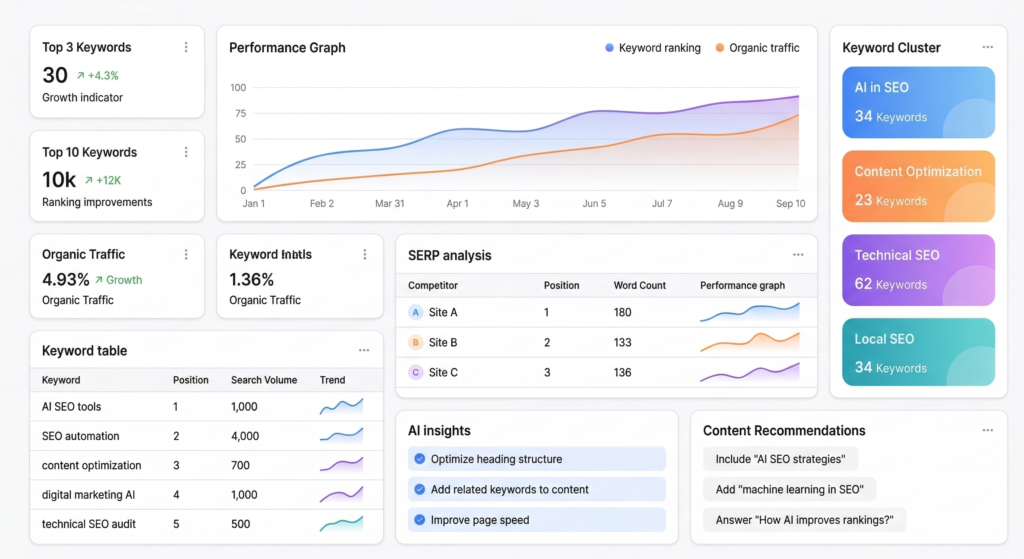
AI dashboard showing keyword analysis and ranking insights.
A few years ago, SEO work meant hours of manual research. Marketers spent days digging through keyword lists, analyzing competitors, and optimizing pages line by line.
Now the workflow is changing.
Artificial intelligence is quietly reshaping how SEO professionals work. Tasks that once took hours can now be done in minutes. Keyword research, content optimization, competitor analysis, and even technical audits are increasingly assisted by AI tools.
But the real shift is not just speed. AI is helping marketers discover insights they often miss manually.
Understanding how AI in SEO works is becoming essential for anyone involved in digital marketing. Those who learn to use it properly gain a strong advantage. Those who ignore it risk falling behind.
Why AI Is Becoming Essential in SEO
Search engines themselves already rely heavily on artificial intelligence. Google’s ranking systems use machine learning models to understand search intent, evaluate content quality, and interpret complex queries.
This means SEO strategies must evolve as well.
Instead of focusing only on keywords, modern SEO focuses on intent, context, and user experience. AI tools help marketers analyze massive data sets to uncover patterns behind successful rankings.
For example, an SEO professional working on an e-commerce website may need to analyze hundreds of product pages. Manually evaluating search intent and content structure would take days.
An AI tool can scan the top ranking pages in minutes and reveal patterns such as:
content length trends
common headings used by competitors
frequent keyword variations
questions users often search
This insight helps marketers make faster and smarter optimization decisions.
How AI in SEO Is Transforming Keyword Research
Keyword research used to start with a simple seed keyword.
Marketers would generate a list, filter by search volume, then manually choose relevant terms. The process worked, but it often missed deeper search intent signals.
Modern AI powered tools take a different approach.
They analyze large search datasets and automatically group related queries. Instead of producing a flat list of keywords, they show how topics connect.
Imagine a digital marketer working for a SaaS company offering project management software.
Traditionally they might target a keyword like “project management tools”.
An AI system might reveal clusters such as:
project management tools for remote teams
best project management software for startups
free project management tools for small teams
These clusters help marketers build topic based content instead of isolated pages.
Many marketers now rely on platforms like Ahrefs, SEMrush, or Surfer SEO for AI assisted keyword analysis. These tools identify content gaps and ranking opportunities much faster than traditional manual research.
AI Powered Content Optimization
Writing SEO content used to rely heavily on intuition.
A marketer would analyze top ranking pages, guess the ideal length, and try to include relevant keywords naturally.
AI has changed that process dramatically.
Content optimization tools now evaluate the structure and relevance of a page compared to the current search results. They analyze elements such as:
semantic keyword coverage
content depth
heading structure
topic completeness
For example, imagine a digital marketing agency creating a blog post about AI in SEO.
An AI optimization platform might suggest including related terms such as:
machine learning in search
AI SEO tools
AI content optimization
These recommendations help ensure the article covers the topic comprehensively.
Tools like Surfer SEO and Clearscope are commonly used for this purpose. They analyze the current search engine results page and suggest improvements that align with what Google already ranks.
Technical SEO Improvements Using AI
Technical SEO often feels overwhelming, especially for large websites.
Site speed issues, crawl errors, broken links, and indexing problems can hide deep within thousands of pages.
AI tools are increasingly helping identify these problems automatically.
Imagine managing an online store with 20,000 product pages.
Running a traditional technical audit might produce a massive report filled with complex data. Sorting through it manually can take hours.
AI based auditing tools prioritize issues based on impact.
For example, they might highlight:
pages blocked by robots.txt that should be indexed
duplicate product pages competing for the same keyword
slow loading category pages affecting rankings
Platforms such as SEMrush Site Audit and Screaming Frog are beginning to integrate AI features that simplify technical analysis.
This allows SEO teams to focus on fixing the most important issues first.
Real Life Examples of AI in SEO Campaigns
Many marketers are already using AI in SEO in practical ways.
Example 1
A content marketer working for a travel blog wants to rank for “best places to visit in Thailand”.
Instead of manually researching dozens of travel websites, they use an AI powered SERP analysis tool.
Within minutes they discover that top ranking pages consistently include:
destination comparison sections
travel cost breakdowns
seasonal travel tips
By structuring their article similarly, they improve their chances of ranking.
Example 2
An e-commerce company selling fitness equipment uses AI to analyze competitor content.
The tool reveals that competitors ranking for “home workout equipment” consistently include buyer guides and comparison tables.
The marketing team updates their content to match this structure and improves rankings within weeks.
Example 3
A digital marketing agency managing multiple client websites uses AI tools to detect internal linking opportunities.
The system scans all published articles and suggests linking related topics together.
Common Mistakes Marketers Make When Using AI
Despite its benefits, AI can create problems when used incorrectly.
One common mistake is over automation.
Some marketers rely entirely on AI generated content without adding human insight or expertise. This often results in generic articles that lack originality.
Another mistake is ignoring search intent.
AI tools may suggest keywords or content structures, but they cannot fully understand audience needs without human judgment.
Successful marketers treat AI as a powerful assistant, not a replacement for strategy.
Human creativity, industry knowledge, and storytelling remain essential.
The Future of AI in SEO
The role of AI in SEO will only grow stronger.
Search engines continue improving their ability to understand language, context, and user intent. AI powered search features such as Google’s Search Generative Experience are already changing how results appear.
This means SEO professionals must adapt.
Future SEO strategies will likely focus more on:
topical authority
content depth
user experience
structured information
AI tools will assist with research and analysis, but human expertise will guide strategy.
For deeper guidance on search optimization practices, marketers can explore Google’s official documentation at Google Search Central.
Conclusion
Artificial intelligence is not replacing SEO.
It is transforming how SEO work gets done.
Tasks that once required hours of manual effort can now be completed quickly with the help of AI tools. Keyword research, content optimization, and technical analysis are becoming more efficient and data driven.
But the most successful marketers are not simply relying on AI.
They combine AI insights with human expertise, creativity, and strategic thinking.
For digital marketers, the message is clear.
Learn how to use AI in SEO effectively. Treat it as a powerful assistant that enhances your workflow.
Those who master this balance will build stronger content, smarter strategies, and better search visibility in the years ahead.