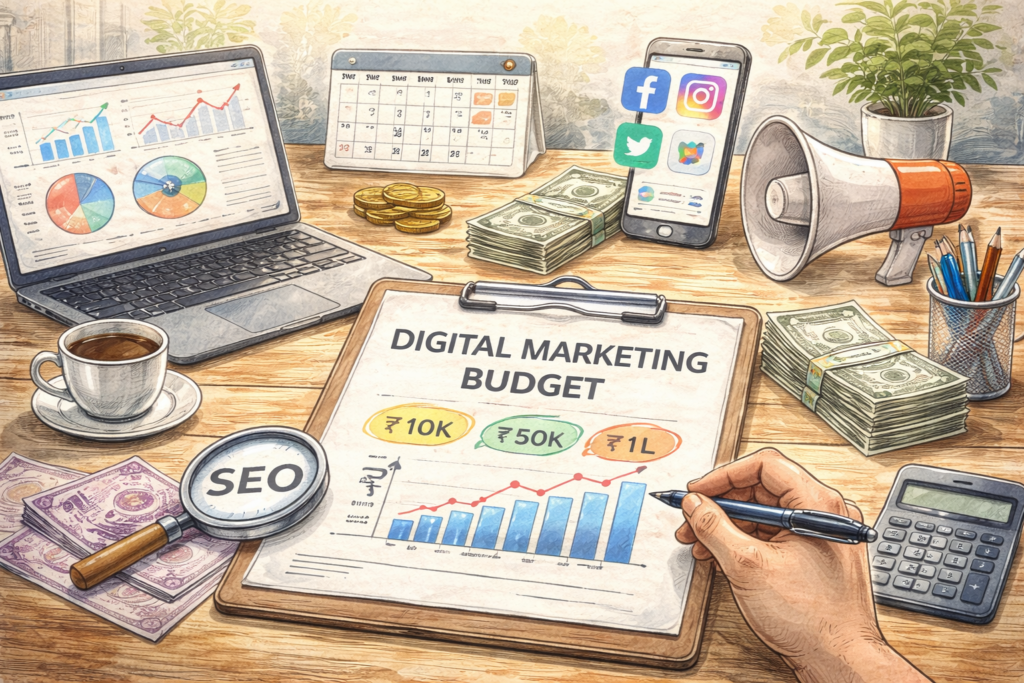
If you ask ten business owners how much they should spend on digital marketing, you will hear ten different numbers.
Some believe ₹5,000 per month is enough. Others say you need ₹2 lakhs or more to see real growth.
Both can be correct.
The real problem in 2026 is not deciding a number. The real problem is that most businesses spend without structure. Money gets split across too many channels, campaigns get paused early, agencies get changed quickly, and results never compound.
A realistic digital marketing budget for small business growth is not about spending more. It is about spending with clarity.
If you want structured execution instead of random spending, professional digital marketing services can help you plan channel wise allocation and ROI tracking.
This guide explains what a practical budget looks like in India today and how to allocate it properly.
Quick Answer: Digital Marketing Budget for Small Business
Starter budget: ₹10,000 to ₹25,000 per month
Growth budget: ₹25,000 to ₹60,000 per month
Aggressive growth: ₹60,000 to ₹1,50,000 per month
Ads allocation: 30% to 50%
SEO allocation: 20% to 50%
Expected ROI window: 3 to 6 months for most businesses
First, Understand What You Are Actually Paying For
Before deciding numbers, understand where the money goes.
A digital marketing budget for small business typically includes:
Agency or freelancer fees
Ad spend on Google and Meta platforms
Content and creative production
Landing page development
Tracking and analytics setup
SEO tools and optimization work
Many business owners think marketing budget equals ad spend. That is incomplete.
Campaigns fail when websites are weak, landing pages do not convert, or tracking is missing. High converting funnels and tracking systems are usually built as part of professional digital marketing services.
Budget Depends on Business Math, Not Just Industry
Industry matters, but your economics matter more.
Ask these questions first:
How many leads do you need monthly?
What is your average customer value?
What is your profit margin?
How long is your sales cycle?
Are you targeting fast sales or long term visibility?
Industry data shows that most companies decide their spend using small business marketing budget benchmarks tied to revenue and growth targets.
If one client generates ₹1 lakh profit, spending ₹25,000 monthly is logical.
If one client generates ₹2,000 profit, budget planning must be tighter and conversion focused.
A smart digital marketing budget for small business always connects to revenue math.
Budget Range 1: ₹10,000 to ₹25,000 per Month (Starter Stage)
This is the entry level range for many small businesses in India.
Best suited for:
Local service providers
New businesses testing demand
Businesses entering digital for the first time
What you can realistically execute:
Google Business Profile optimization
Basic website SEO fixes
1 to 2 blogs per month
Basic social media presence
Limited local ads testing
What you should not expect:
High enquiry volume
Instant rankings
Multi city reach
Aggressive scaling
At this level, focus on one priority channel instead of splitting efforts.
Budget Range 2: ₹25,000 to ₹60,000 per Month (Growth Stage)
This is the most practical digital marketing budget for small business expansion. Businesses at this stage usually combine structured SEO services for small businesses with paid ads to balance growth.
Best suited for:
Clinics
Real estate firms
Education institutes
Home service businesses
City level competition brands
Execution strength at this budget:
SEO content and internal linking
Google Ads search campaigns
Conversion focused landing pages
Remarketing campaigns
Google Business activity growth
Tracking and analytics optimization
This range balances short term lead generation with long term organic visibility.
Budget Range 3: ₹60,000 to ₹1,50,000 per Month (Aggressive Growth)
This level supports serious scaling.
Best suited for:
Multi location businesses
High margin services
Franchise brands
Companies entering new cities
Marketing capabilities unlocked:
SEO content clusters
Authority and backlink building
Multiple service landing pages
Google Ads plus Meta Ads
Video creatives and advanced design
Full funnel retargeting
Weekly optimization cycles
This budget works best when your sales process is ready to handle volume.
Digital Marketing Cost Differences in India
India offers cost advantages compared to western markets.
Key observations:
Cost per click is significantly lower
SEO production costs are affordable
Regional targeting reduces ad waste
Tier 2 cities have cheaper acquisition costs
However, competition has increased sharply since 2023. Cheap clicks do not always mean cheap leads anymore.
Budget Allocation: Smart Channel Split
If Your Priority Is Fast Leads
50% Google and Meta Ads
30% Landing page and conversion optimization
20% SEO foundation
If Your Priority Is Long Term Growth
50% SEO and content
30% Google Ads high intent campaigns
20% remarketing and social support
If Your Priority Is Brand Building
40% SEO and educational content
30% social media distribution
30% retargeting ads
Channel mix must match business goals and timelines.
Industry Wise Budget Benchmarks in India
Real Estate: ₹50K to ₹1.5L
Clinics: ₹30K to ₹80K
Education: ₹40K to ₹1L
Home Services: ₹20K to ₹60K
Ecommerce Starter: ₹50K+
These ranges vary based on competition and geography.
How to Calculate Your Marketing Budget (Simple Formula)
Example calculation:
Service value: ₹30,000
Profit margin: 40%
Profit per client: ₹12,000
If cost per lead: ₹1,000
Lead to customer conversion: 10%
Customer acquisition cost: ₹10,000
Still profitable.
This is how digital marketing budget for small business planning should work. Always reverse calculate from profit.
Real Budget Scenario Example
Local Clinic Case
Monthly budget: ₹35,000
Google Ads: ₹20,000
SEO: ₹10,000
Landing page: ₹5,000
Average leads: 60
Patient conversions: 18
Revenue impact becomes measurable within 90 days.
Even modest budgets can produce ROI when structured properly.
The Biggest Budget Mistakes Small Businesses Make
Spreading budget across too many channels
Hiring based on lowest price
Stopping campaigns too early
Running ads without landing pages
Ignoring conversion tracking
Expecting SEO results in weeks
Copying competitor strategies blindly
Focused execution beats scattered spending.
Ads Budget: What You Should Know
Many businesses ask how much to allocate for ads.
A practical starting point:
₹300 to ₹1,000 per day is enough to generate performance data. Many businesses start with this range under conversion focused Google Ads management services. Google explains account billing and spend cycles in its Google Ads cost and billing basics documentation.
Do not scale until you understand:
Cost per lead
Lead quality
Conversion rate
Sales closure ratio
Scaling without data burns budget quickly.
SEO Budget: Beyond Blog Writing
SEO is often misunderstood.
It includes:
Technical optimization
Site architecture
Internal linking
Service page expansion
Search intent content
Authority backlinks
Google’s SEO starter guide explains how technical structure and content quality influence rankings.
SEO compounds over time. It is not a one month activity. Long term growth usually requires structured execution through professional SEO services.
Social Media Budget Role in 2026
Social media works best for:
Brand trust
Customer education
Retention
Remarketing
For most service businesses, social media supports search. It rarely replaces it as the main lead source.
How to Know If Your Budget Is Working
Early performance signals include:
Higher website engagement
Improved enquiry quality
Lower cost per lead
Better keyword visibility
Higher landing page conversions
If these metrics do not improve, the issue may be execution, not budget size.
Final Thoughts
A strong digital marketing budget for small business success is built on clarity, not guesswork.
Small budgets should focus deeply on one channel. Larger budgets should balance ads and organic growth.
Consistency matters more than scale in the early stages. Structured execution always outperforms random spending.
Need Help Planning the Right Budget?
Many businesses waste money because they start campaigns without a structured allocation plan.
If you want clarity on how much to spend, where to spend, and what results to expect, professional planning makes the difference.
Explore our digital marketing services or connect with our team for a customized marketing budget plan aligned to your growth targets.
– Written by AeroSky Digital Strategy Team
Specialists in small business digital growth across India.